
| Wells Gray for Birdwatchers, Wildlife Viewing, and Wild Flora |
All areas of Wells Gray seem to get a good selection of smaller native species... Varied Thrushes, Grossbeaks, Swallows, etc. As well as larger birds like Spruce Grouse and Ruffed Grouse. Specific areas get more impressive birds, here's few locations and species of note: Osprey: at least 4 nesting pairs on Clearwater and Azure Lakes every year. Murtle Lake has over a dozen nesting pairs. Bald Eagles: seen in the fall on the Clearwater and North Thompson Rivers during the Salmon run. nesting pairs on Murtle Lake. Herons and Cranes: often sighted at the Ray Farm, in the river channel between Clearwater and Azure lakes, and in Murtle lagoon. Owls: Greys, Great Horned, and Screech owls have all been spotted or heard, a very wild sight or sound to experience! mostly found in the old growth areas of the park. Rare Waterfowl: Harlequin Ducks and Wood Ducks make nesting season appearances on Murtle Lake and in the Azure River channel. Loons, Grebes, and Mergansers are common on all park lakes, especially Murtle. What do you call a flock of Loons? We don't know either, but you can see groups upwards of 70 birds floating together on Murtle Lake, apparently very rare behavior for this bird often only seen in pairs. Hummingbirds: Rufous and Calliope species can be found. Good places to spot them are around Helmcken Falls Lodge, and at the Ray Farm. |
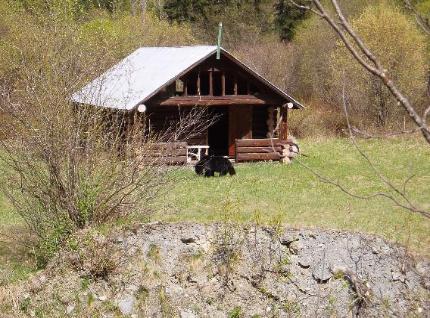
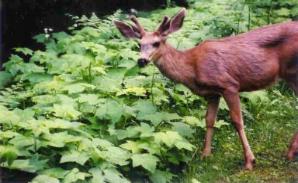
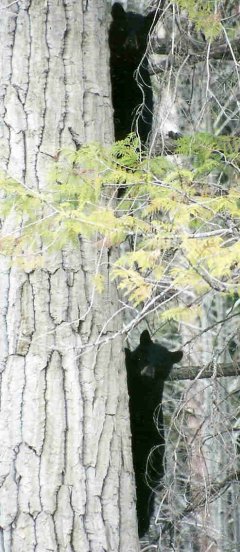
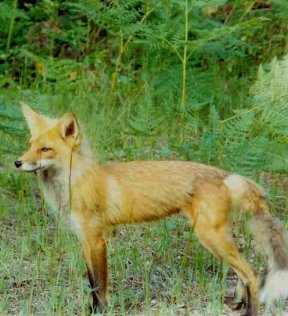
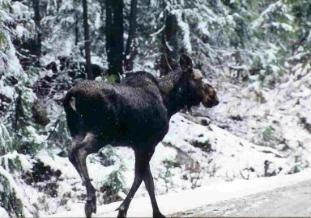
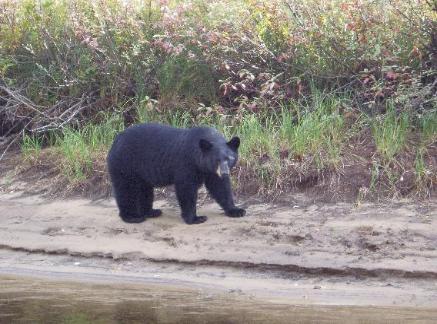
Bears: Bears are everywhere! Keep your eyes open for Black Bears from dawn to dusk in every part of the park, and along local roads in the North Thompson Valley. I can honestly say that I have seen bears in every part of Wells Gray, from the high alpine to the middle of lakes...so, be Bear Aware. Our Black Bears are not all black! They range in colour from blonde, to cinnamon, to chocolate brown, and several shades of black. Some look almost dark blue in the right light. Grizzly Bears are rare and much harder to encounter. Alpine meadows are the most common area to see one, like the Trophy, Battle, and Phillips Lake areas. Even then sightings are rare. A recent count placed the Grizzly population in Wells Gray at well over 100 animals. Deer: Deer are also common throughout the park, mostly Mule Deer (big ears), with a few Whitetail Deer now moving into the area. Moose: Moose are common in the park, but hard to spot. They are a very reclusive animal compared to the deer, and to see one, you usually have to catch them by surprise. Seeing a moose in Wells Gray is a lucky experience, treasure it if you do. Caribou and Mountain Goats: Both are found in Wells Gray, but both are very rare sights. Goat populations exist on the mountain tops on both sides of Azure Lake, and in select areas around Murtle. Foxes, Wolves, and Coyotes: All three are common to the park. Foxes are seen frequently along roadways and come in colours from red to black, plus many shades in between. Coyotes are generally grey and are comparable in size to a medium dog, like a Springer Spaniel. Coyotes hunt mice and Ground Squirrels, often in the farmers fields near the park. Wolves are common in the park, but are more often heard howling at night. Several resident packs live around Murtle, Clearwater and Azure Lakes, and on the highlands in between the three. I've seen well over 2 dozen wolves in 20 years working here. Cougars and Lynx: Both cats reside in the park, but are very rare sights, consider yourself lucky if you see either. Beaver, Otters, and Muskrats: All three reside in Wells Gray and area. Several beaver ponds and lodges can be seen along the North Thompson River, in Shadow Lake, Alice Lake, and the Stillwater area. Otters can occasionally be seen playing on the big lakes and rivers. Muskrats can be found almost anywhere in smaller lakes. Muskrat houses, piles of matted grass, are common in Murtle Lagoon. Smaller Mammals: Snowshoe Hares, Pine Marten, Fisher, Mink, Ground Squirrels, Pack Rats, Skunks,Porcupines, various mice, and voles all inhabit Wells Gray and Area. keep your dog on a leash for its own safety . |
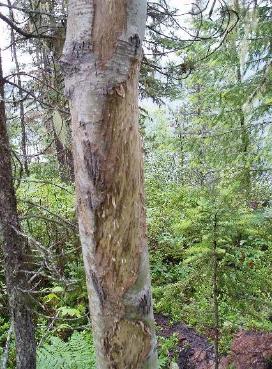
This tree on Easter Bluff trail has been
stripped of bark by a porcupine.
stripped of bark by a porcupine.
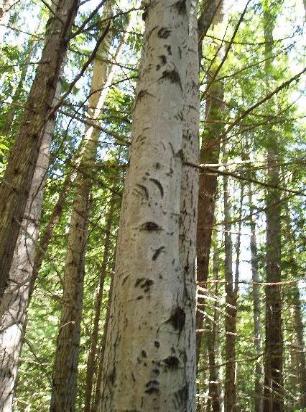
Bear claw scarred Birch tree on Whale
Lake Trail - this tree has scarring that
goes back nearly 30 years.
Lake Trail - this tree has scarring that
goes back nearly 30 years.
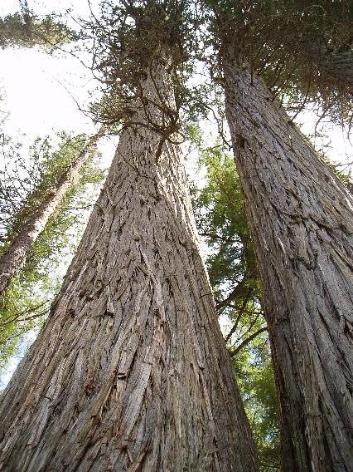
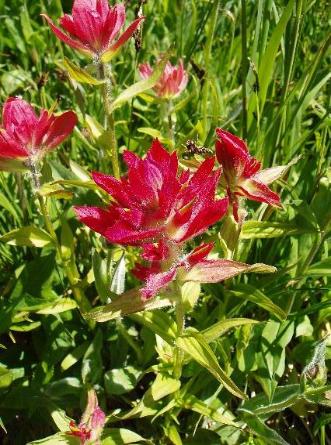
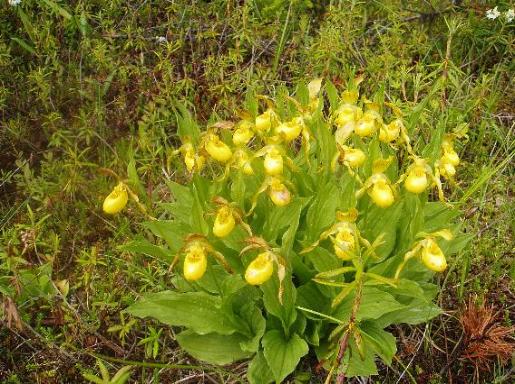
Lilies. Wells Gray is a botanist's heaven. Entire books can and have been written on the botanical life of Wells Gray, so I won't go into huge detail here. There are the Trophy and Battle Mountain alpine meadows, which flower in two waves between late June and August. The sides of the roads throughout the region have some form of wildflower in bloom from June until August. You have marshlands like Placid Lake, Murtle Lake and the Ray Farm which are home to both Ladyslipper (June 25th at Placid is good) and Fairyslipper Orchids, plus dozens of other flower species and interesting plants. There are old growth Cedars at Spahats, Bailey's Chute, Placid Lake, the Clearwater Lake boat launch, and Rainbow Falls, just to name a few locations. Plus, you have every other tree species from Birch to Hemlock to Pine to Sub-alpine Fir. Interesting tree mixes can be found on the Placid Lake Trail (monster Cottonwoods, Spruce, and Cedars), on the Bailey's Chute Trail, and around Ray Farm. |

 |
 |
 |
 |
 |
 |
 |
 |
 |
 |
 |
 |
 |
 |
 |
 |
 |
 |
 |
 |
 |
 |
 |